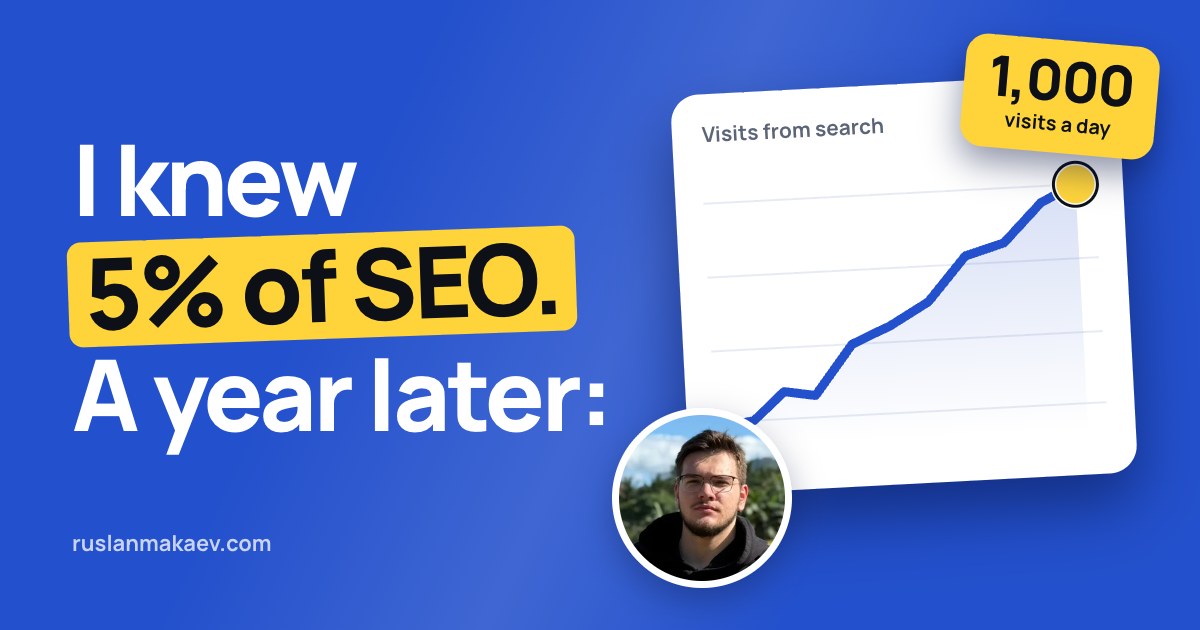
I knew 5% of SEO. A year later: 1,000 visits a day
What a year of SEO on a local online store taught me: go natural, measure everything, earn trust, and be patient.

Ruslan Makaev
· 14 min read
When I took over SEO for a local online store, I knew maybe 5% of it: meta tags, and that was it. A year later the store got about 1,000 visits a day from search. Here is everything I learned on it and on my other sites and tests, the way I’d tell a friend who is just starting out.
A year in numbers
Where I started
The project is a local online store that sells its own products with delivery. It’s under NDA, so no name and no niche here.
I built the site from scratch and ran all of its SEO for more than a year as a freelancer. It was also my first PHP project: I learned the language along the way, with AI.
Go natural
The main thing I understood after a year: go natural. Don’t build by made-up rules: keyword maps, topic clusters, all those tips. Don’t listen to them. You don’t need backlinks at the start either: they won’t help if you don’t yet know what really works.
Going natural means building the site for people first. Start with the home page. When it’s done, fill it with content, improve it, make it nicer to look at. Look at your competitors and make things a little more convenient.
Make it familiar. Don’t run wow experiments the market isn’t used to. The market already exists without you: look at the structure and the visuals people are used to, and make yours the same or a bit simpler. At the very least, start the same: just copy how a competitor from the top 5 does it, ideally number one. Then stand out a little: slightly better visuals, a bit of wow.
But don’t get lost in the visuals. Keep the focus on the product. I made this mistake more than once: I focused on the visuals and the website when the real focus should have been the product. Nothing should distract people from it: no complex sidebars, menus or effects. Make everything convenient and clear.
Show, don’t tell
And the most important part. Sites are for your customers, and your customers are people. People don’t need to be told, they need to be shown. They don’t read texts, they scan pages with their eyes. So focus on showing your product, or whatever your site is about.
Keep the site simple, and spend the budget on a good photoshoot instead of effects. Even just your product on a white background, but shot so well that people feel it right away.
A great example is BOXRAW, a boxing clothing store. You look at it and immediately think: great models, great quality. They invested in the shoot, the models and the feeling; even the poses come from boxing. Training gear and everyday clothes are split, shot in the gym and outside. The descriptions are short. They show more than they tell, and that’s why the site is so pleasant: you land on it and start exploring the products right away.
They also have enough products to show. If you have only a few, think carefully about how to present them. And don’t build huge pages that scroll forever: people get tired and lose interest. Though in some niches that might be exactly what works.
Grow one page at a time
Going natural also means growing naturally. You don’t need clusters, huge pages and lots of categories while your site is still empty. Don’t make 50 pages because a keyword map says so, when you won’t have the strength and resources to make them well. Unless you have a big agency with its own rules. And if you’re reading this, you clearly don’t.
Go step by step and do each step well. For an online store: the home page, then the catalog, then product pages. Every page convenient, good-looking and focused on the product.
Then let real demand choose the next page. Search Console or Yandex Webmaster will show you where people find you. Say you deliver to two big cities, but people mostly find you from one of them: make a separate page for that city. Then pages for categories. Then a seasonal one, like Christmas. Then the places you work in. You don’t need many pages. Pick them precisely and make each one well.
Measure everything from day one
As soon as the site is live, register it everywhere: Google Search Console, Yandex Webmaster, Bing Webmaster Tools, Semrush, Ahrefs, OpenSEO and the like. Let them collect data.
Add analytics: Google Analytics, Yandex Metrica, PostHog, whatever you know, and track how many people come. Analytics matters a lot, because it’s what you’ll change the site by: it shows how people really use it.
Learn to read every page and the whole flow: which pages people land on, how far they scroll, what they click. The more you know, the easier it is to adjust. If people only scroll to the third screen out of ten, either the third screen is boring and they leave there, or the whole page is overloaded.
Let your AI agent read the numbers
To speed up analytics, connect the APIs, Google’s and Yandex’s. Where an API doesn’t give you what you need, export files and keep them in one place. The goal is a system where your AI agent can calmly analyse the history of your site: Search Console, Yandex Webmaster, analytics.
Then you can just ask. We published this page a month ago: how much did it change traffic, and where do its visitors come from? Did the new post land at all? If not, give it more time or change something in it.
By my estimate it cuts the time 10x, if not 20x, because going through everything yourself is tedious. Set it up once, and it pays off for a long time.
Keep the site alive
Start a blog and keep it alive. If you write with AI, first write down rules for good posts: look at how great blogs do it, like Semrush’s and Ahrefs’.
Write about what really happens: a collab, an event you ran or were invited to, a talk you gave, something useful for your customers or your niche. "We did this in our niche, and here’s what came out." A live blog with your own insights.
Make a glossary page too, and fill it with genuinely interesting content for your niche. If you sell books, make a glossary of book terms.
And keep the whole site evergreen. To me that means active: you keep posting, updating, changing, adding. Published an article and then learned something new? Add it. That’s going natural too.
Be patient
You’ll have to wait two to three years for the real results anyway. My first results came after six months to a year, and that’s about when you start to see whether the site is alive.
Growth comes in jumps, but over time it adds up to a fairly even line.
Stand out in the results
When you finally reach the top 10 for some queries, you have to stand out for people who scroll down. They should want to click you more than your neighbours. If competitors look better and their texts are simpler and clearer, people will click them.
Everything counts here: the title, the description, reviews, stars, ratings, the icon. Work on it carefully and run A/B tests.
To check this, I built two small tools: one for the favicon, one for the title and description. You put in your real competitors for a query, with their icons and texts, and see whether you stand out. Would people click you if you were fourth?
The two tools
Wrap the candy, but not like a Chupa Chups
Then work on how you present it. Wrap the candy in a beautiful wrapper, just not like a Chupa Chups: by the time you get it open, you’ve lost your nerves. Like a normal candy: you open it, eat it, it’s tasty and beautiful.
Start with the link preview. When someone shares your link, a beautiful image should come up with it: a short, clear line on the left, a great photo on the right.

Then the snippet in search. The title, the description and the icon decide whether people click at all, and that’s what the two tools above check.
Then the first screen of every page. If you have a catalog and someone opens a product, the first screen should be the product itself: its photos first, the texts after. No extra texts or visuals in front of it.
Look at each page through the eyes of the person who came for one thing, and give them that thing first.
The top two get buyers, the rest get explorers
One thing took me a year to understand. When I started these sites, I estimated traffic from the top three competitors: they get this much, so I’ll take a bit less. The math doesn’t work like that, though looking back it’s logical.
In the top 5 you’ll get clicks, but not the sales. A hot buyer opens the first or second result, mostly the first. From fourth place down, the people who click are explorers. They’re researching, remembering where to buy later, maybe saving you to bookmarks, just looking at what you have.
Explorers matter too, and for them the site has to be great: a strong offer, or a site so clear and good they think "wow". You have to earn their trust. Show your reviews on the site, let people leave one after an order, show your Google, Google Maps or Trustpilot reviews. If you don’t have those pages, create them, and ask customers for feedback.
Give people a quick way to reach you, for example a chat widget that opens after a while. Just make it convenient. Many widgets are clumsy and scary, with unpleasant texts and unpleasant conversations. Keep it as simple and light as possible.
At first you won’t be number one. You’ll be in the top 10 at best, and there only explorers click. When you’re number one, sales come anyway: you’ve won the race. But to get there, you first have to win the explorers.
Bring the first visitors yourself
For that, you also need to bring people yourself. Search engines need to see that people stay on your site and explore it. Buy ads for your strongest page, the one you just built: on Meta, Google, Yandex. Watch how people behave and make that page stronger. If the ads work and pay off, keep running them until the site brings enough without them.
Or use social media. Start accounts, post when you publish something, find groups in your niche and post there regularly. You collect links, follow or nofollow, and people come little by little. On Instagram, show your products, link to the site, share updates in stories.
In one of my SEO tests, social media brought almost 1,000 people in a single day to an empty site that had just launched. That traffic had its own rules, which we ran into later, but it worked. That was a good case; there were worse ones. You have to try, try and try again.
SEO is like running a business: all you can do is raise your chances, one try at a time. And every try should be a real shot that you learn from.
Fix the errors, but they’re 5 to 10%
Once the trackers are set up, make sure the site has no errors, and ideally no warnings either. To find them you don’t need anything expensive: Screaming Frog is free for up to 500 URLs, and OpenSEO is open source.
By my feeling, the technical side is 5 to 10% of your success. Even a weak site with no H1s, no backlinks and lots of errors can grow if it takes off well or brings in lots of good customers, as long as it’s fast and clear for people.
Still, it’s one more step that raises your chances. Make the site error-free, simple and clear. Use all the basics: titles, structured data (JSON-LD), sameAs links to your social profiles. Link your pages to each other, of course. I can’t say how much that matters, because I always had it by default.
What the site is built on doesn’t matter. What matters is that it’s built well and scales: when you add something new, you change it in one place, by standard best practices. A convenient base with no junk, no hardcode and no duplicates where you can avoid them. But that’s a story about development, and this one is about SEO.
Collect links the natural way
Register on other sites so you have backlinks. Backlinks are just signals that your site exists and can be trusted. Google especially loved them. It has changed since, but they still help you grow.
Get partners in neighbouring niches to mention you. Say you sell food, and a drinks brand has the same customers: help each other, they write about you, you write about them. Or you worked on another company’s New Year party: let them publish a post about their event and mention you with a link. A partner friendship.
Each search engine trusts something different
Google, Yandex, Bing and the others see your site differently.
For Google, relevance and domain trust matter more. Backlinks too, but not that much. What counts is that your site already gets traffic and has held it steadily in its niche for at least six months to a year. For Google, that’s a kind of trust. This is the ceiling the store has hit: people click it well, but Google doesn’t put it above the old players yet.
Yandex, in my tests, looks more at how people respond: how long they stay, what they click, how active they are on the site.
Bing is like Google ten years ago. Texts, technical basics, backlinks, and it will most likely pick you up first. For me Bing usually came first, while Google might not bring a single click yet.
Get ready for AI search
The world is moving to AI, so make your site easy for it to read. Have a clear sitemap, link it in the footer or follow best practices, so every detail about you can be found on the site. When people ask their AI agents about you, the agent should find everything.
Make it easy for people too. Put buttons in the footer or on your pages, like "Ask your AI about us", with a ready prompt for ChatGPT, Claude, Perplexity, Gemini and the assistants popular in your market, like Alice in Russia. I have them at the bottom of my home page.
My guess is that in 5 to 10 years most of this will go through AI agents. Some things will stay and the systems will adapt, but it has already started: Google Search Console now shows how often your pages appear in AI Overviews and AI Mode, and Bing Webmaster Tools counts citations in Copilot. So prepare early and learn bit by bit.
Want to grow your site the natural way?
If your site should bring customers from search and doesn’t yet, write to me. I’ll look at it and tell you where I’d start.
Text me