My own site is the longest-running project I have. The git history starts on 16 January 2024 and has 104 commits, and the site has been through six visibly different versions since. This page shows each of them as it looked, what changed and why it mattered.
Stack
- React
- TypeScript, TS
- Vite
- Tailwind CSS
A personal site is a product too
For an engineer, a personal site is the one product where you are the client, the designer and the developer. Nobody sets the deadline, so every decision shows what you value: what you show first, what you hide, how it behaves on a phone, whether a search engine can read it.
I treat it that way. It is the place where I try things I would not risk on a client project, and it is public, so the history of those attempts is visible. Some of them were weak, and the February 2025 phone version is the clearest example.
Six versions, in order
Each version is shown on desktop and on a phone, built from the commit that matches the date (the current home page and /v2 were captured from the live site on 14 October 2026).
A light one-column CV
The first commit is from 16 January 2024. This version is a single white card on a lavender background: avatar, "Frontend Engineer", a Key facts block, a Skills block and a "See the CV file" button. It did the one job of a CV page, and nothing more. What changed after it: the page grew a layout and a menu.
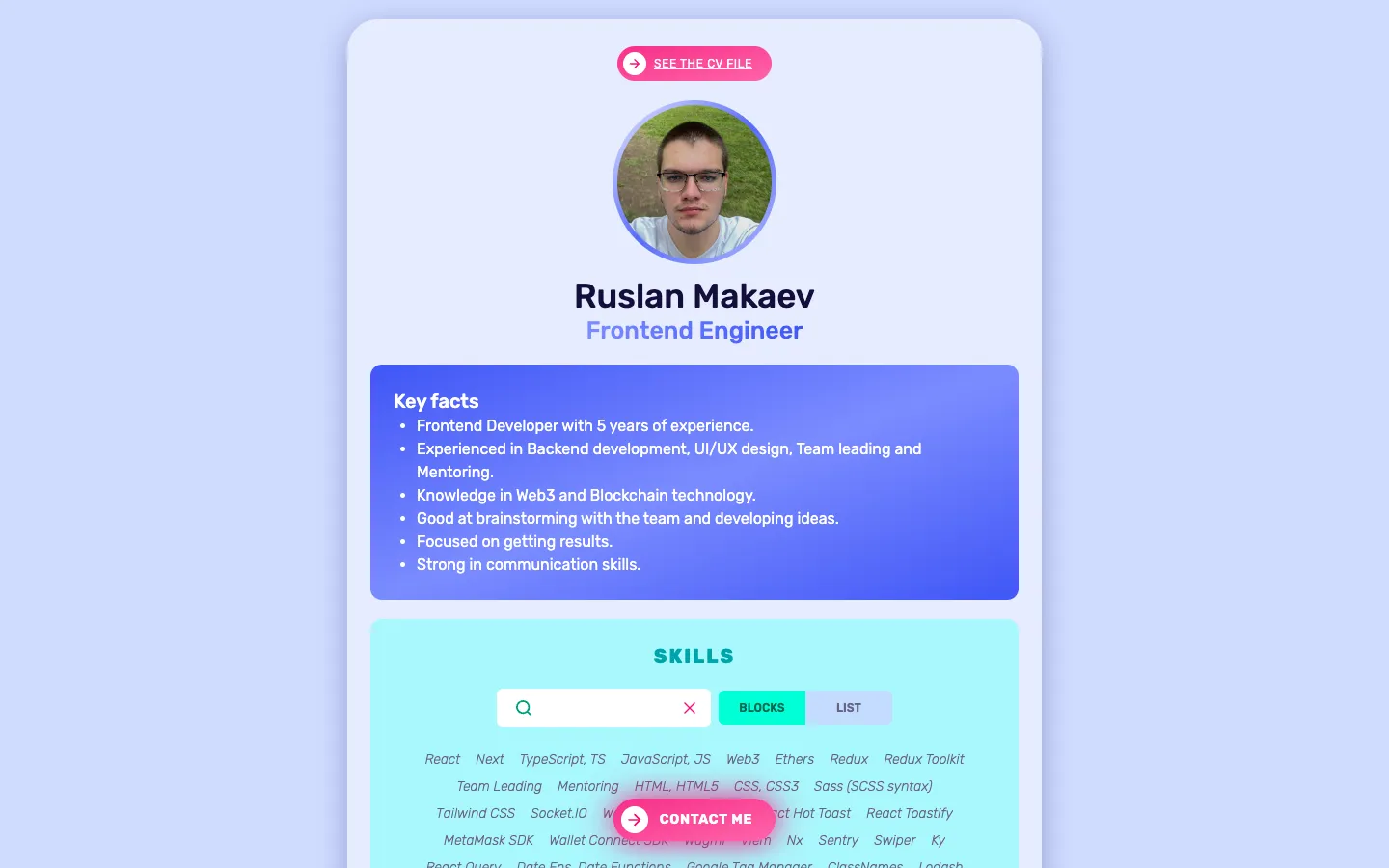
January 2024, desktop 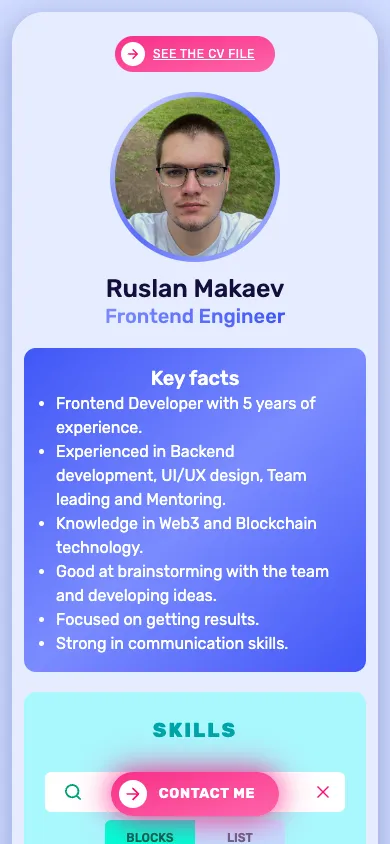
January 2024, phone A blue layout with a side menu
From August 2024 the design was reworked: a left menu (About, Skills, Experience, Recommendations, Education), a red ring around the avatar and a gradient block with highlighted words. Why it mattered: the page stopped being a single card and became a navigable CV.
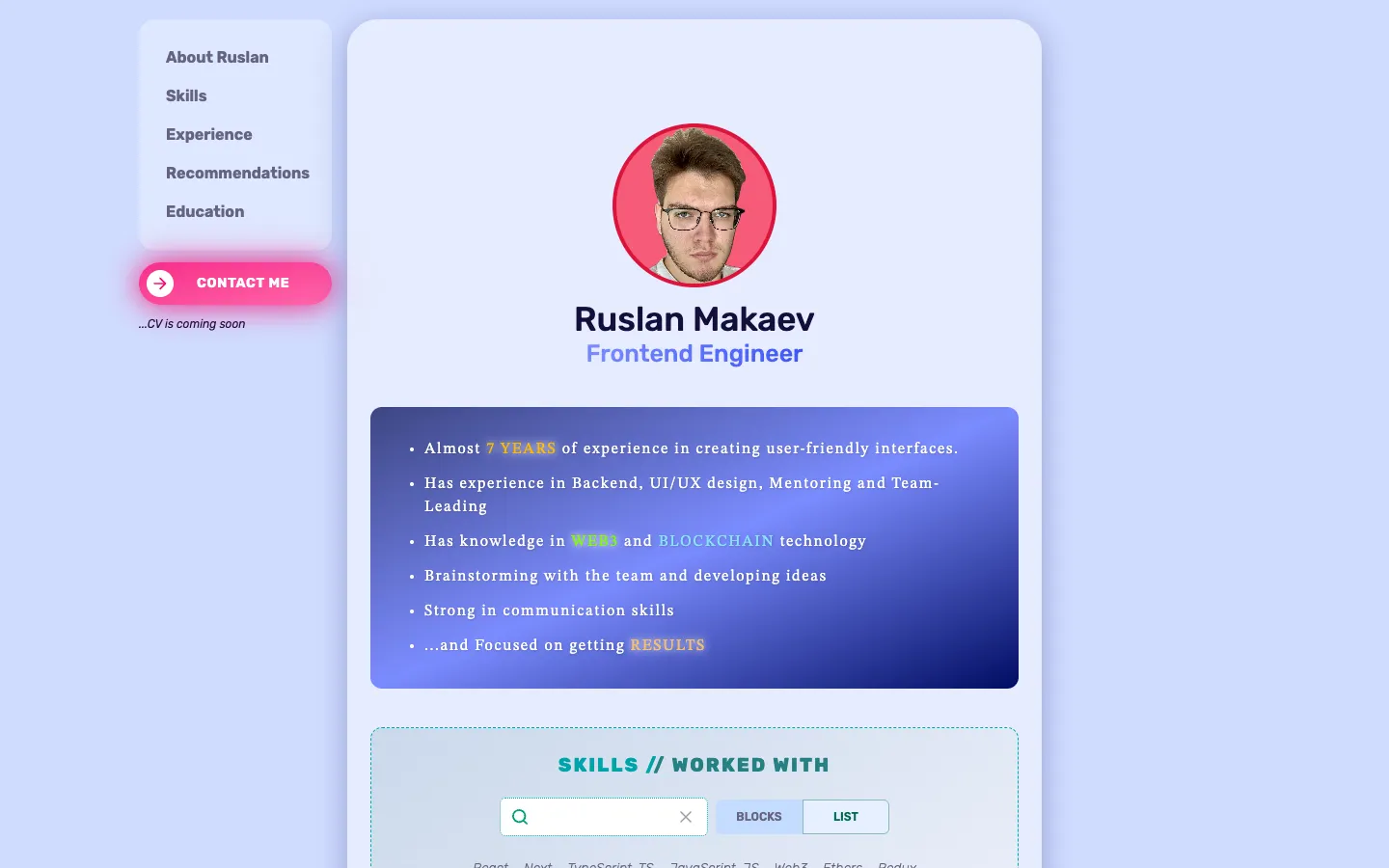
September 2024, desktop 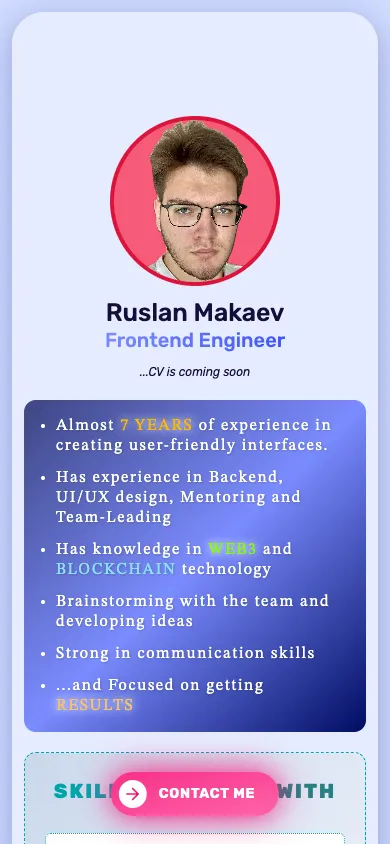
September 2024, phone A dark site called "Recruitment patrol"
A full visual restart on a separate branch: a black sidebar with the photo, my name in large capitals, skill tags, and a "Recruitment patrol" block with a resume button next to a career section. The honest weak spot: the phone view was a stub that said "Adaptive is coming". What changed and why it mattered: the content moved toward recruiters, and the missing mobile version became the next thing to fix.
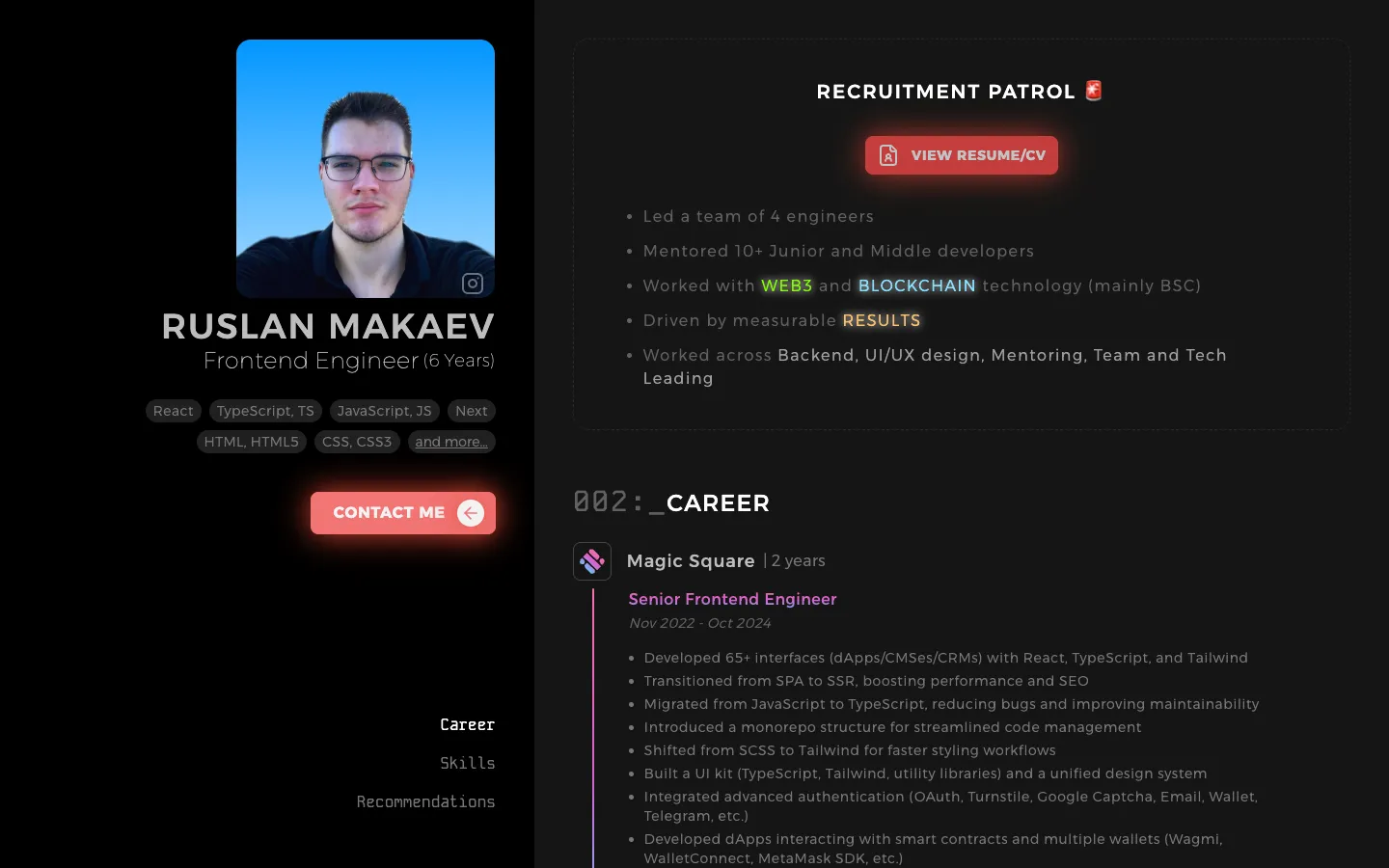
February 2025, desktop 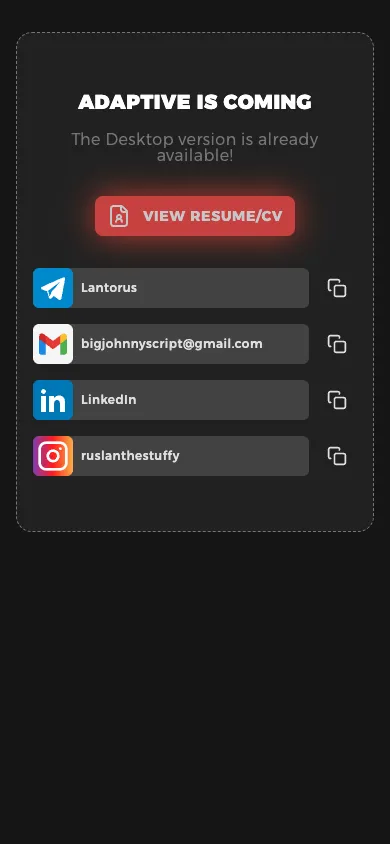
February 2025, phone A dark overview dashboard
The dark line continued as an Overview dashboard: counters for years in the industry, skills and hours, a career section with "Contract Works & Freelance", and Contact me and View CV buttons. The phone layout became a real adaptive version, which closed the gap left in February.
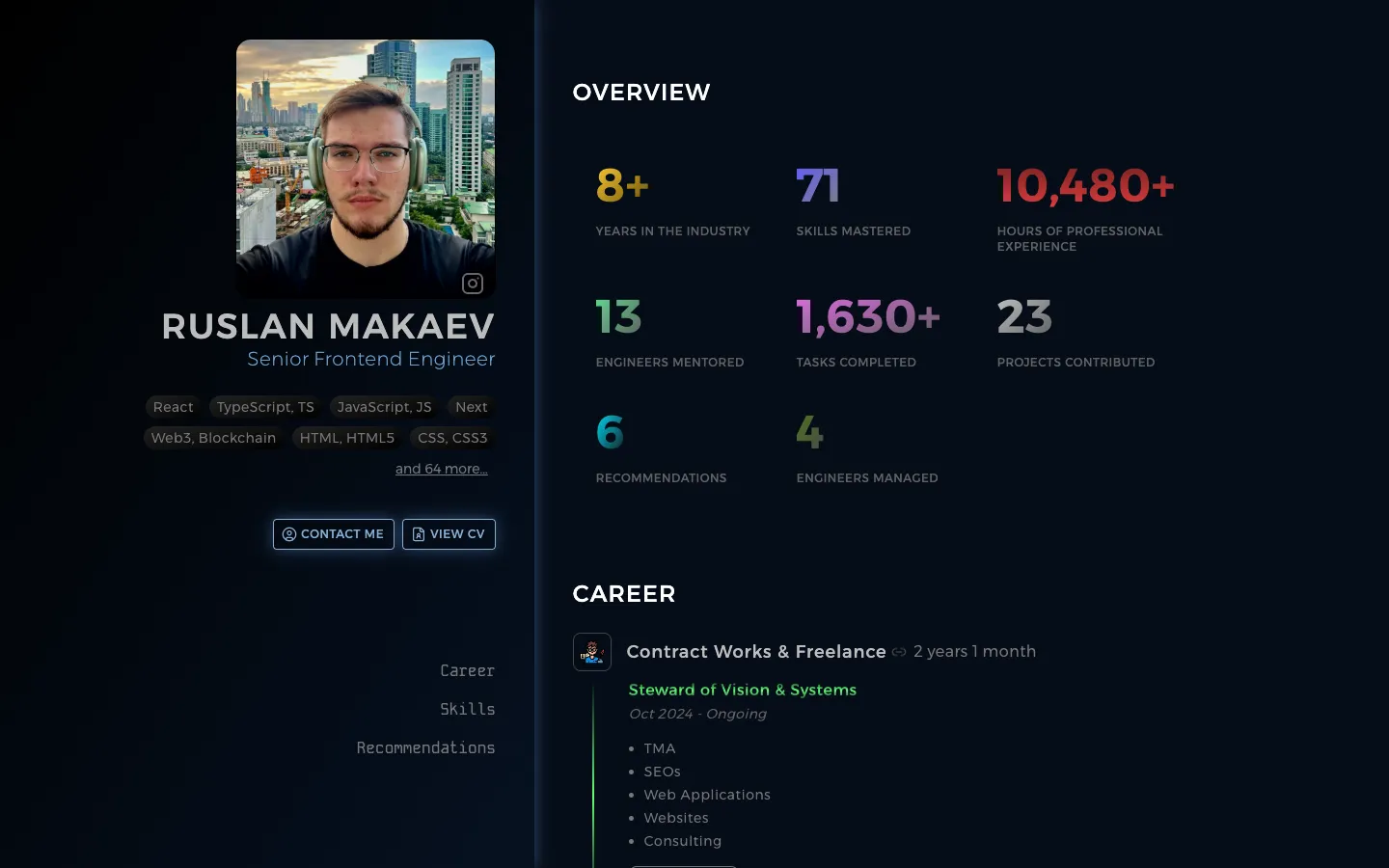
December 2025, desktop 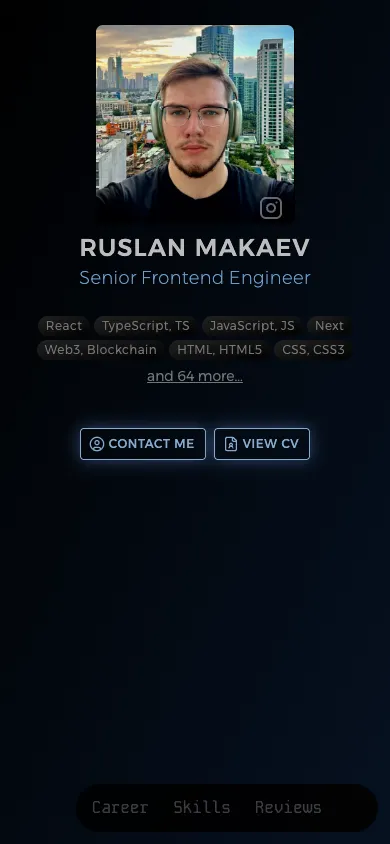
December 2025, phone Multiple pages, case studies and public projects
Since 2 May 2026 the site is a set of routes instead of one screen: a Public Projects block with screenshots, case studies (the first one, Euromat, is announced at the top) and a burger menu. It moved to react-router and vite-react-ssg, so every public route is prerendered to static HTML and search engines see real content. This is the version you are on now.
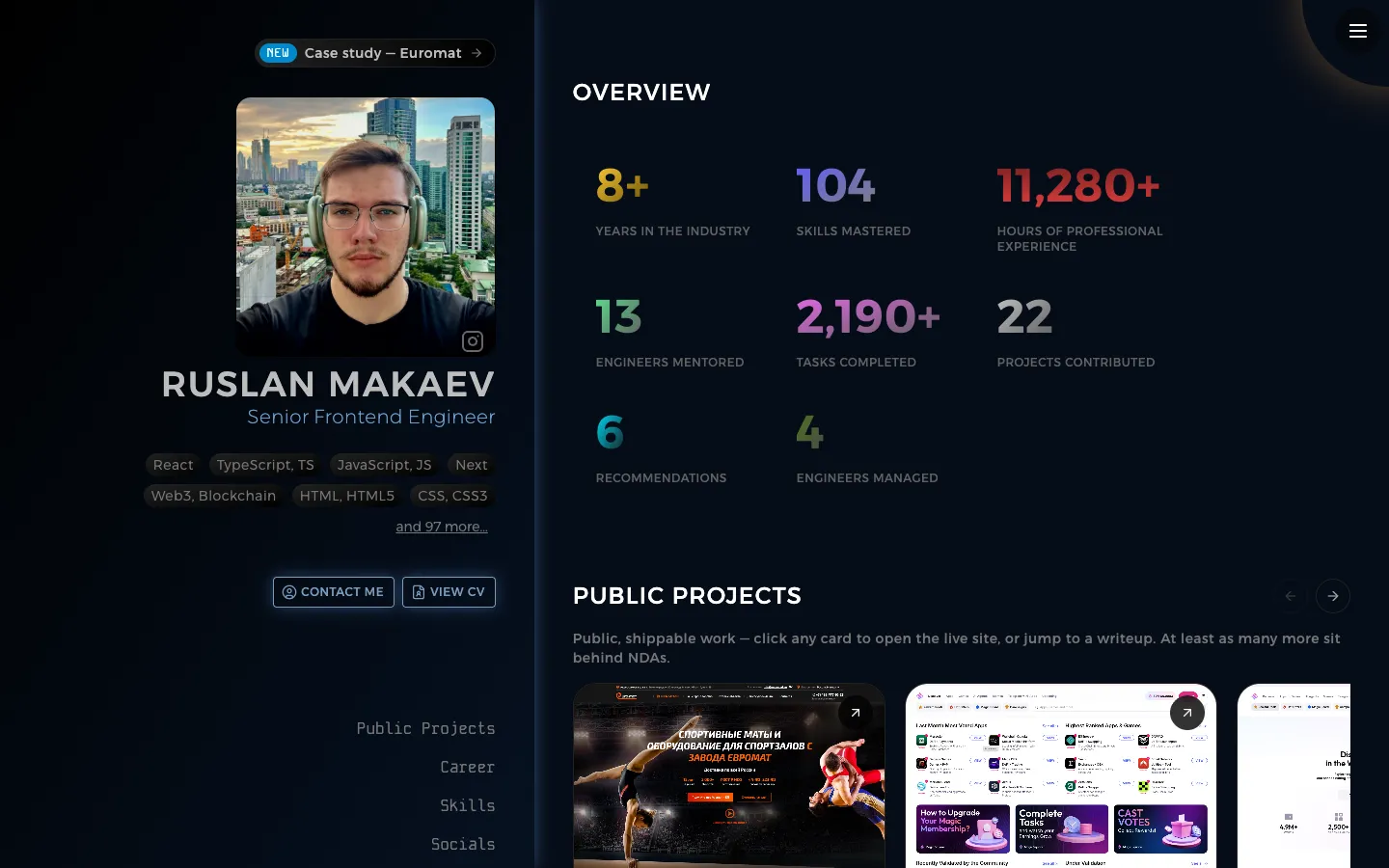
May 2026 to now, desktop 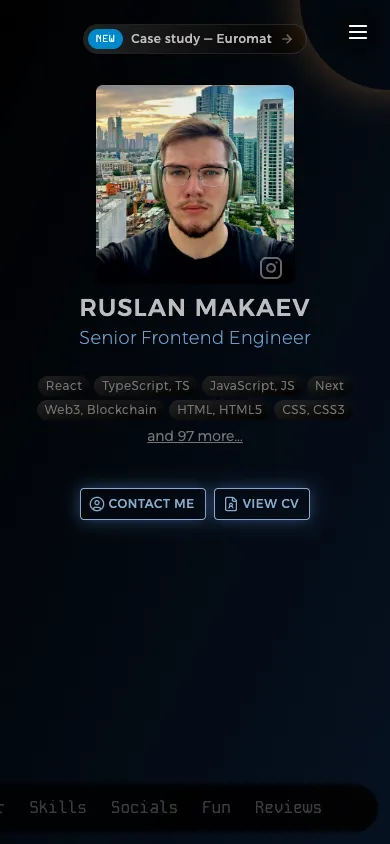
May 2026 to now, phone A sheet of paper (the /v2 experiment)
Started on 13 October 2026 and published as an open draft: warm paper with a window shadow, a handwritten "Hi, I'm Ruslan" heading, a photo as a polaroid, two sticky notes ("my stack, last 5 years" and "my stack now") and a pen. It carries a DRAFT label and a link back to the classic site. It adds three.js and is a test of how far a personal site can go from the dashboard format.
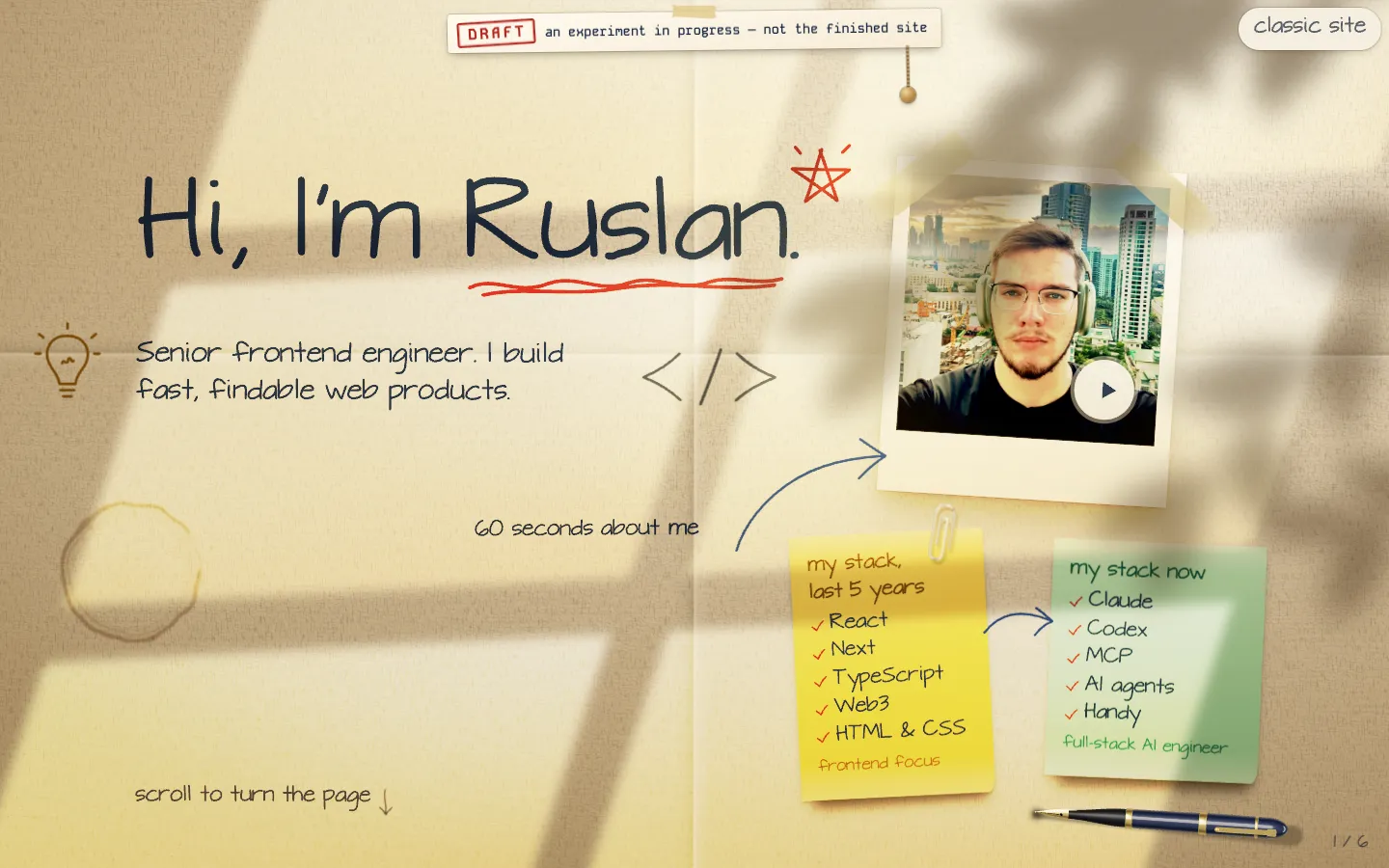
October 2026, desktop 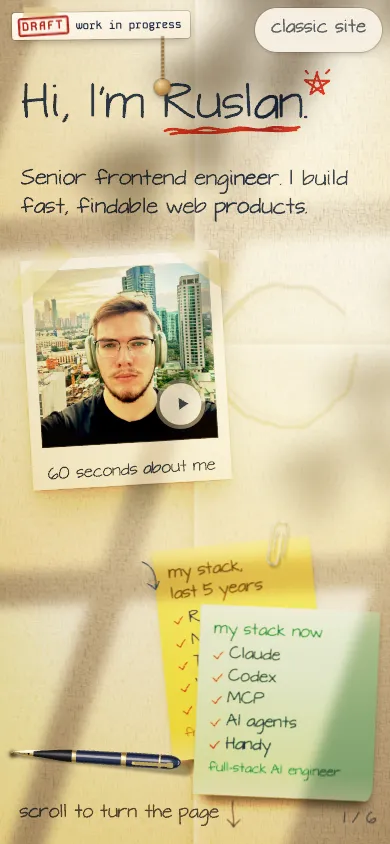
October 2026, phone
What stayed the same
- The stack: React 18, Vite 5, TypeScript, Tailwind 3 and framer-motion in every version from 2024 to 2025. Since 2026 it also uses react-router and vite-react-ssg.
- Content lives in TypeScript files and rendering stays separate from it, so a redesign changes the components and leaves the text alone.
- The goal: one page that tells a visitor who I am and what I have built, without making them dig for it.
Where it goes next
The /v2 sheet of paper is a public draft, not a replacement of the classic site. I built it in about two days: Claude Code orchestrated AI subagents (Opus, Sonnet and Haiku) while I set the direction and reviewed the results. You can open it at https://ruslanmakaev.com/v2.
The classic site stays the indexable one: every public route is prerendered, so search engines read real HTML. What happens to /v2 depends on how it holds up in use.
Want a site that grows with you?
If you need a fast, findable site built in React and TypeScript, or an AI-assisted build process with a human in charge of the result, reach out via the contacts on my home page.